|
||
46. Flow lines |
| Listing of Structures |
| Back...Next |
| Meteorite - Antarctica,
chondrite, unclassified. Meteorite - Bilanga, achondrite, diogenite. |
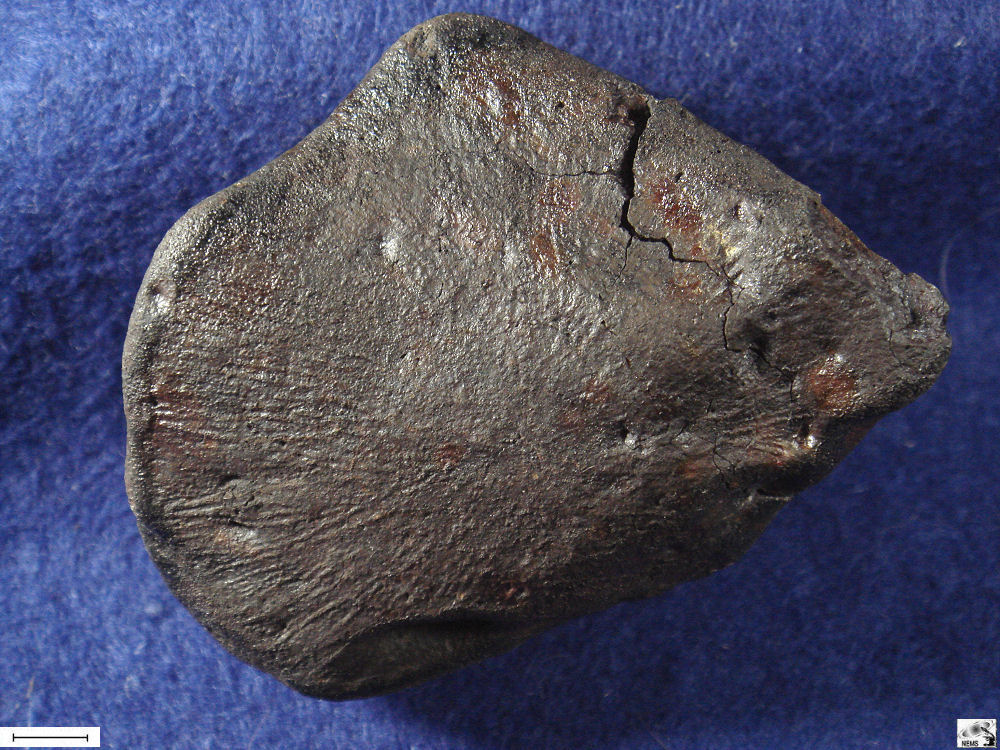
| Figure 1.. Scale bar 7 mm. |
| Meteorite: Antarctica, chondrite, unclassified. |
| Flow lines, fold-over lip, oriented. |
| Arrival |
| Meteoroids enter Earth’s atmosphere at
hypervelocity, with typical speeds ranging from approximately 11 km/s
(Earth’s escape velocity) to as high as ~72 km/s. These velocities are
controlled by the body’s heliocentric orbit, mass, bulk density, and entry
angle (Ceplecha et al., 1998; Love & Brownlee, 1991). Intense aerodynamic heating begins at altitudes of roughly 100–80 km as kinetic energy is converted into thermal energy through shock compression of atmospheric gases and frictional interaction at the surface. Surface temperatures sufficient to melt silicate minerals commonly reach 1,300–1,600 °C, although the precise values depend on entry velocity, composition, size, and the efficiency of radiative and convective heat transfer (Genge & Grady, 1999; Ramdohr, 1967). Under these conditions a thin film of melt forms on the exterior. Aerodynamic shear and inertial forces drive this low-viscosity liquid rearward across the surface. Upon quenching, the migrating melt solidifies as a glassy to microcrystalline coating—the fusion crust—typically only 0.1–2 mm thick (Genge & Grady, 1999; Buchwald, 1975). Within this crust the directional movement of the melt is preserved as fine, parallel or slightly radiating streaks known as flow lines. Flow lines are most clearly developed on oriented meteorites—specimens that maintained a stable attitude during flight rather than tumbling. In such cases the leading face experiences continuous ablation and commonly assumes a rounded or conical morphology, while molten material streams consistently toward the trailing edge. The resulting flow lines radiate from the stagnation point and may terminate in rolled-over lips or splash features along the rear margins (Nininger, 1952; Genge & Grady, 1999). These morphological indicators record both the direction of flight in the final stages of deceleration and the relative viscosity and cooling rate of the melt film. Because the fusion crust itself is the product of progressive ablation and mass loss, flow lines constitute primary evidence of the aerodynamic environment experienced during atmospheric passage. They provide a valuable record of orientation history, ablation dynamics, and the physical state of the melt layer at the moment of solidification. |
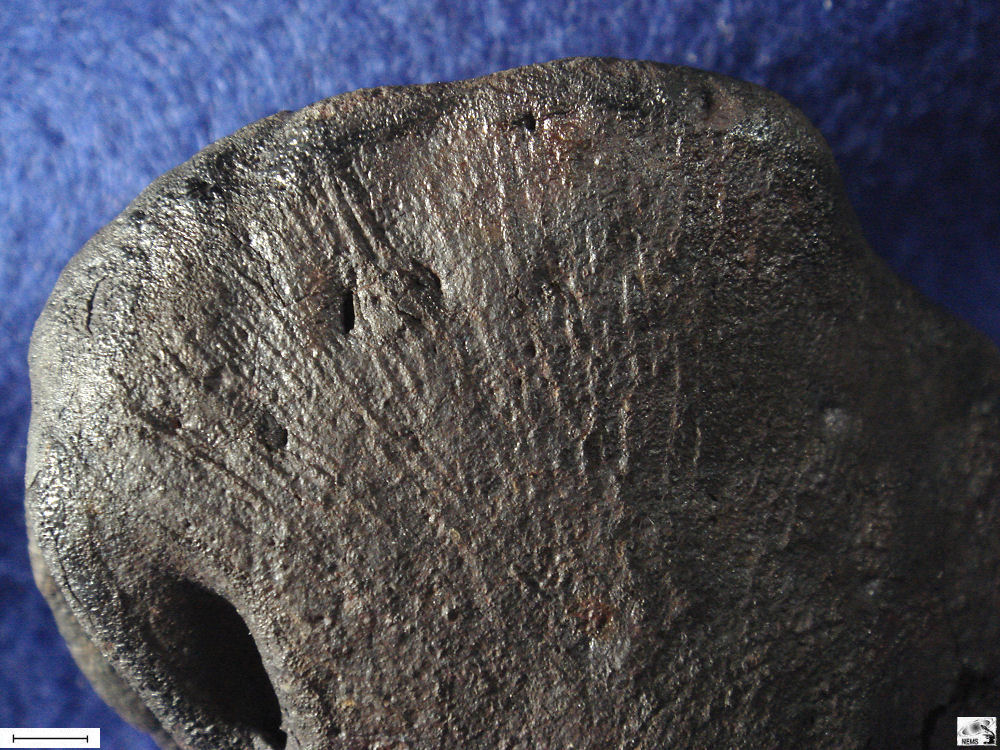
| Figure 2. Scale bar 4 mm. |
| Meteorite: Antarctica, chondrite, unclassified. |
| Flow lines, oriented. |
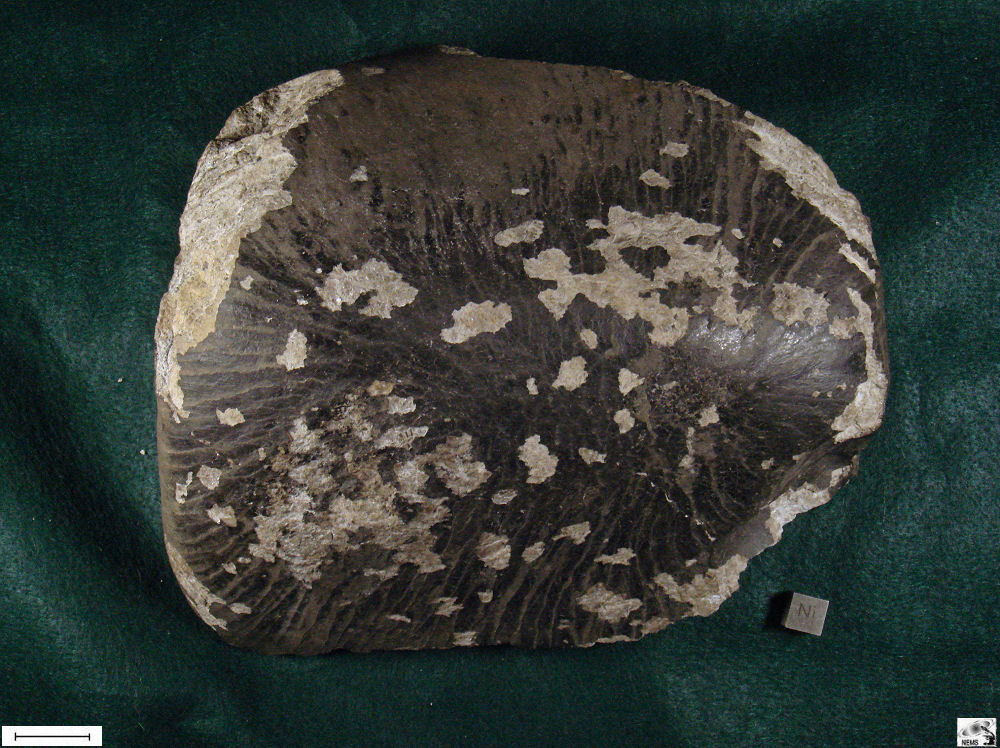
| Figure 3. Scale bar 20 mm. |
| Meteorite: Bilanga, achondrite, diogenite. |
| Flow lines, oriented. |
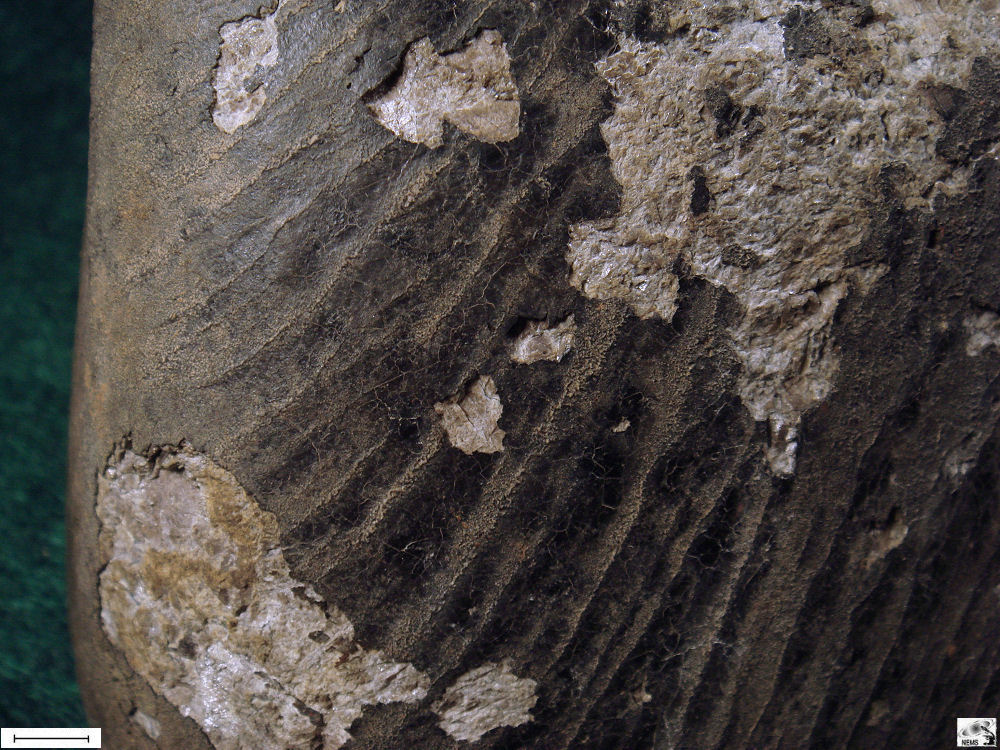
| Figure 4. Scale bar 8 mm. |
| Meteorite: Bilanga, achondrite, diogenite. |
| Flow lines, oriented. |
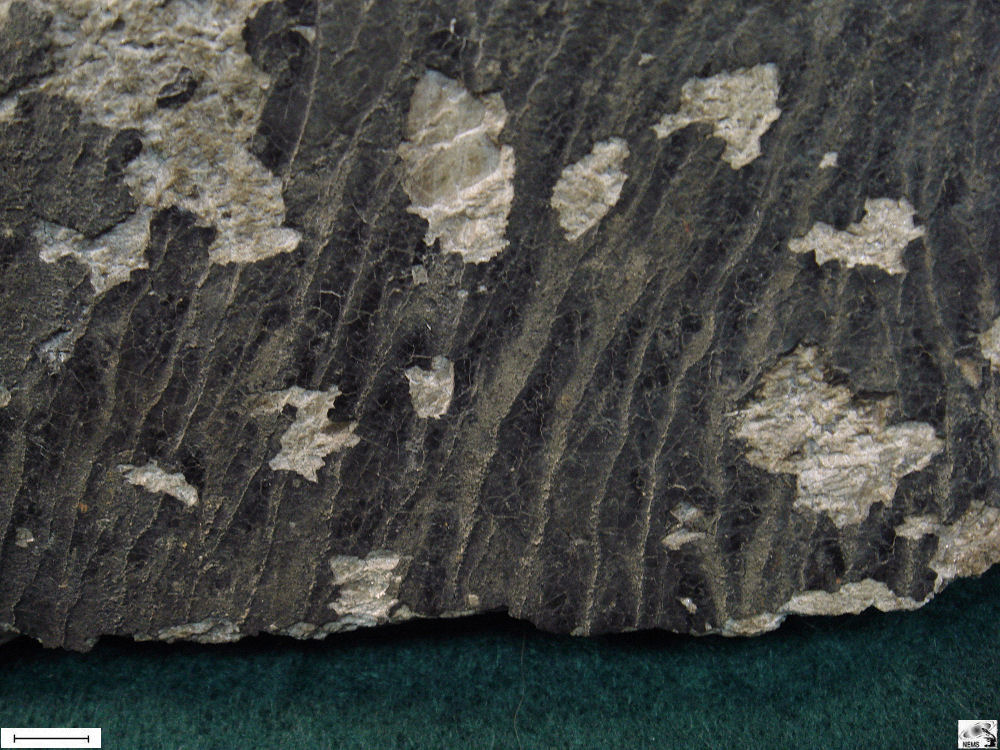
| Figure 5. Scale bar 8 mm. |
| Meteorite: Bilanga, achondrite, diogenite. |
| Flow lines, oriented. |
| References • Buchwald, V. F. (1975). Handbook of Iron Meteorites. University of California Press. Ceplecha, Z., Borovicka, J., Elford, W. G., ReVelle, D. O., Hawkes, R. L., Porubcan, V., & Šimek, M. (1998). • Meteor phenomena and bodies. Space Science Reviews, 84(3–4), 327–471. • Genge, M. J., & Grady, M. M. (1999). The fusion crusts of stony meteorites: Implications for the atmospheric reprocessing of extraterrestrial materials. Meteoritics & Planetary Science, 34(3), 341–356. • Love, S. G., & Brownlee, D. E. (1991). Heating and thermal transformation of micrometeoroids entering the Earth’s atmosphere. Icarus, 89(1), 26–43. • Nininger, H. H. (1952). Out of the Sky: An Introduction to Meteoritics. University of Denver Press. Ramdohr, P. (1967). Die Schmelzkruste der Meteoriten. Earth and Planetary Science Letters, 2(3), 197–209. |
| Listing of Structures |